Working Mothers Are Doing Two Full-Time Jobs, and One Is Completely Invisible. Here's the Data.
The "second shift" is not a metaphor. It is a measurable labor structure where working mothers continue working the moment their paid work day ends. Here is the research, the data, and the 4 specific systems that actually create breathing room.

Avery Hayes
Mom Of Two
April 20, 2026 · 13 min read

The phrase "second shift" came from sociologist Arlie Hochschild in 1989. She was studying working mothers and realised they were coming home from paid work and starting, essentially, a second full day of unpaid work. Not alongside their partners. Primarily alone. Nearly forty years later, every piece of new data confirms the pattern has not gone away. It has just moved locations.
The location change is the remote work revolution. Working from home was supposed to make this easier. For many working mothers, it did the opposite.
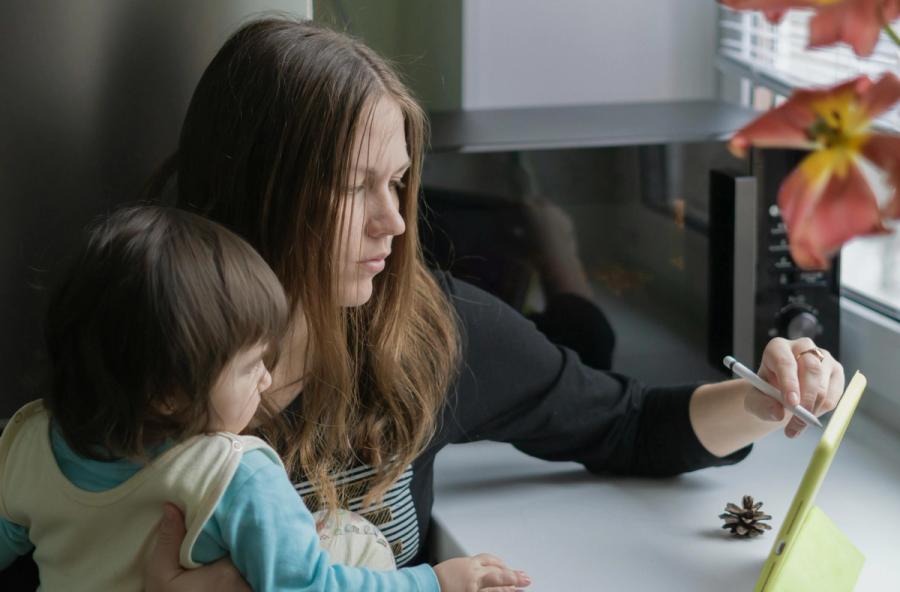
The term "second shift" and why it still matters
Hochschild's original finding was that working mothers were putting in an extra month of 24 hour days per year compared to their husbands. The book that came out of that research, The Second Shift, gave the pattern a name that stuck.
Modern research has only sharpened the picture. A 2025 Norwegian mixed-methods study of 602 parents, covered in NORA: Nordic Journal of Feminist and Gender Research, found that even in Norway (one of the most gender-egalitarian countries in the world, with 49 weeks of parental leave and highly subsidised childcare) the "third shift" of emotional and cognitive administration of family life remains unequally distributed. Couples with strong stated ideals of equality still live out traditional patterns when measured.
A gendered division of invisible third shift tasks is present even among couples who express strong ideals of gender equality and share household chores equally. Even with equal distribution of physical household chores, mothers experience more everyday life stress than fathers.
Norwegian mixed-methods study of 602 parents, NORA, June 2025
If it is not fully resolved in Norway, it is not going to be resolved by any working mum reading this through sheer effort. This is structural. Which is both relieving (you didn't cause it) and daunting (you can't individually fix it). What you can do is build specific systems that protect you from the worst of it.
The remote work double-edged sword
Here is where it gets personal for a lot of us. Remote work, which was supposed to rescue working mothers, has in many cases entrenched the pattern.
Working from home, women spend 1.5 more hours per day on childcare than their pre-pandemic counterparts. Men working from home barely changed their contribution.
That data is from a 2024 National Women's Law Center study summarised in the 2025 Women's Day analysis. The logic plays out in almost every house I know. When mum works from home, mum also handles the sick kid, the late pickup, the delivery driver, the laundry between meetings. When dad works from home, dad works.
This is not because dads are bad. It is because the household defaults to the person who is both present and has historically held the mental load. Remote work collapsed the physical boundary that used to protect working mothers (the office). Now the second shift overlaps with the first. Which means there is no off switch.
If you recognise this: the issue is not willpower. It is structure. You need physical and temporal boundaries that the household treats as non-negotiable, the same way you would treat a meeting at an office. "I cannot be interrupted between 2 and 4" has to be defended as rigidly as if you were not in the house.
The career cost nobody warned you about
The second shift doesn't stay at home. It shows up on your paycheque and your career ladder. The same 2025 analysis documents what is called "the motherhood penalty," which is separate from the gender pay gap.
Women with children under 6 earn approximately 76 cents for every dollar fathers of the same-age children earn. This gap has narrowed just 3 cents since 2020.
Mothers are 42% less likely to receive callbacks for job interviews than equally qualified women without children. The penalty is on the CV, not the performance.
This matters beyond money. It means that the very women who are carrying the second shift at home are simultaneously being penalised professionally for the existence of the children whose care they are disproportionately providing. The structural bind is full.
I am naming this not to make you feel worse. I am naming it because I spent years thinking my career was plateauing because I was bad at my job. I was not bad at my job. I was a mother. Those are not the same thing, and they should not be treated as such, but they are.
4 systems that actually create breathing room
Individual solutions cannot fix a structural problem. But they can protect you while the structure slowly changes. These four systems come from what actually works in the working mothers I know who are not currently burning out.
Define when paid work starts and ends. Treat those edges as immovable. If your work is 9 to 5, do not respond to Slack at 7pm. If the school needs something at 10:30am, you are in a meeting even if you are at the kitchen table. The boundary is yours to defend, and no one else will defend it for you. Put real consequences on the other side (leaving the house, going for a walk, a lock on your phone). The boundary has to have teeth.
Pick one domain of the mental load (see the mental load post for the full list of nine) and transfer it completely. Not help, transfer. Your partner or another adult takes over ownership, planning, and consequences. Pick the domain that weighs on you most. For many working mothers, that's logistics and schedules, or birthdays, or meal planning. Freeing one domain creates enough space to breathe.
The shift from paid work to family work has no ritual. In offices, the commute used to do this. Working from home, you go from a meeting directly into being mum in 30 seconds, which means you are never fully in either. Create a ritual. A 15 minute walk. A shower. Ten minutes on a book. Whatever signals to your nervous system: one mode is ending, another is beginning. Protect it like it is the most important meeting of the day.
Not a bath. Not a candle. Actual time off that is not "managing family life while alone." Two hours on a Saturday where you are not responsible for anything or anyone. This has to be scheduled, protected, and non-negotiable. It can be alone or with a friend. What it cannot be is you doing the laundry while the kids are at an activity. That is still work. Real recovery time is the hardest thing to claim and the most important.
Frequently asked questions
My job is flexible. Isn't that already the solution?
Flexibility helps, but the research shows it is often used to absorb more unpaid labor rather than to reduce total labor. "Flexible" without boundaries becomes "always available." The flexibility has to be used intentionally, not defaulted into.
What if I actually want to be the primary parent?
Entirely valid. The goal is not to split everything. It is to make the distribution intentional rather than inherited. If you chose to be the primary parent, your partner should be the primary earner, primary house manager, or primary something. The imbalance becomes a problem when one person carries most of everything. Choose your load rather than absorb it.
My partner works longer hours. Isn't it fair that I do more at home?
A reasonable tradeoff in principle. But paid work has clear boundaries. Unpaid domestic work does not. Someone working 50 paid hours per week is still "off" 118 hours. The imbalance in total working hours (paid plus unpaid) is almost always in the mother's direction, according to consistent time-use research. It's worth looking at actual total hours rather than just paid ones.
I can't afford more childcare. What do I do?
Many of the solutions in this post are free. Hard boundaries on work hours. Transferring mental load to your partner. Scheduled recovery time. None of these require paid help. What they require is the willingness to protect your time as if it matters, which is often harder than paying for childcare.
The permission nobody gives you
You are not failing. The data is clear. Working mothers are doing two full-time jobs, and one of them is invisible. That is not an individual problem. It is a structural one. You can still build systems that protect you. You are allowed to.
What's the one hour of the week you most need to protect? Name it in the comments. Put it on the calendar this week.
Read next
Community Discussion
Join 0 parents sharing their thoughts
Loading conversation...
Save this article for later?
We'll send a beautiful copy straight to your inbox so you never lose it.

Avery Hayes
Mom Of Two
Avery Hayes is a mother of two and a parenting writer passionate about helping families through honest, relatable content.
Related Articles

The Family Calendar System That Ends the Sunday-Night Scramble and Keeps Two Working Parents Sane.
Shared family calendars fail in most households because the system is wrong, not the people. Here is the 20-minute weekly sync borrowed from high-functioning families that actually holds up across the week.
The Weeknight Dinner System That Ends the 5pm "What's for Dinner" Panic Forever. Really.
No colour-coded 7-day meal plans. No three-hour freezer prep Sundays. A realistic 5-meal system built for working mothers who have 20 to 30 minutes on a weeknight and a family that actually has to eat. Here is the whole framework.

Why Returning From Maternity Leave Feels So Hard — and How to Survive It
The first 12 weeks back at work after maternity leave reshape you, your career, and your identity in ways no one prepares you for. The research on what protects working mothers during this transition is clear. Here is the practical 12-week framework, week by week.